Innovation Leads the Trend, Quality Drives Value

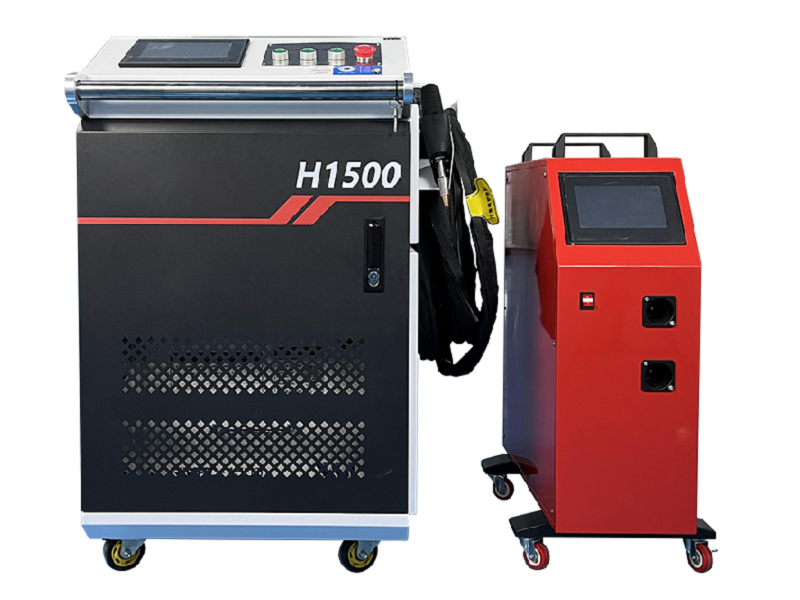
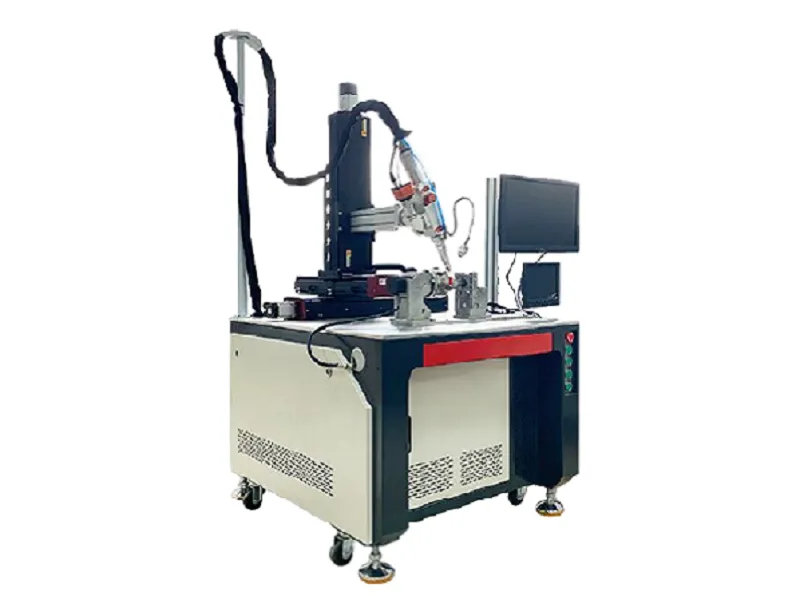
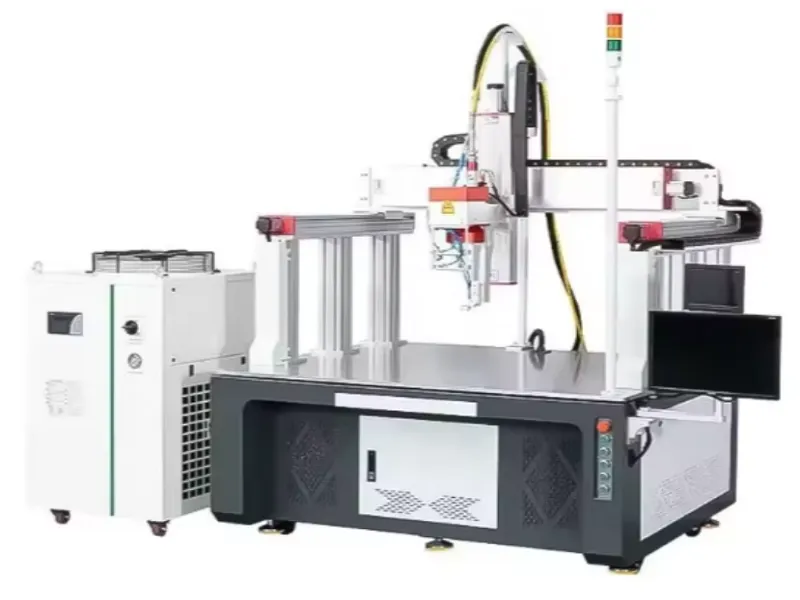
Laser welding machines, also known as laser welders, are welding equipment that utilizes high-energy laser beams for material processing. They are primarily used in the automotive, electronics, biomedical, and mold repair industries. Laser welding uses focused laser light to heat the material, forming a molten pool. This method features a small heat-affected zone, minimal weld distortion, and a high degree of automation. It is suitable for various processes, including spot welding and stitch welding of thin-walled materials and precision parts.
Based on their operating mode, these machines are available in handheld, automatic, and galvanometer-type models. Core components include a laser generator, fiber optic transmission system, cooling system, and control system. The handheld design enhances operational flexibility and is suitable for on-site repairs and small-batch production. Some models incorporate air cooling systems for enhanced portability. Parameters such as laser power density, pulse waveform, and defocus are adjustable. Negative defocus can increase penetration depth and accommodate different material requirements. Laser welding does not require contact with the workpiece, is environmentally friendly and clean, and produces consistent weld quality, but requires high assembly precision. With technological advancements, these devices are evolving towards intelligent and automated systems, and are being integrated with processes such as robotics and 3D printing.
The development of electronic technology, computer microelectronics technology and automation technology has promoted the development of welding automation technology. In particular, the introduction of unit technologies such as numerical control technology, flexible manufacturing technology and information processing technology has promoted the revolutionary development of welding automation technology.
(1) The intelligence of welding process control system is one of the core issues of welding automation and an important direction for our future research. We should carry out research on optimal control methods, including linear and various nonlinear controls. The most representative ones are fuzzy control, neural network control and expert system research of welding process.
(2) Welding flexibility technology is also the content we focus on. In future research, we will organically combine various optical, mechanical and electrical technologies with welding technology to achieve precision and flexibility of welding. Using microelectronic technology to transform traditional welding process equipment is the fundamental way to improve the level of welding automation. Combining numerical control technology with various welding machinery and equipment to improve their flexibility is one of our current research directions; in addition, the combination of welding robots and expert systems to realize functions such as automatic path planning, automatic trajectory correction, and automatic control of penetration depth is the focus of our research.
(3) Improving the reliability, quality stability, and control of welding power sources, as well as their excellent dynamics, is also a topic we focus on. We will develop high-performance welding machines that can adjust arc motion, wire feeding, and welding gun posture, detect the weld bevel, temperature field, molten pool state, and penetration, and provide welding specification parameters in a timely manner. We should also actively develop computer simulation technology for the welding process. Evolving welding technology from a "skill" to a "science" is an important aspect of achieving welding automation.
(1) The required amount of heat input can be reduced to the minimum, the metallographic changes in the heat-affected zone are small, and the deformation caused by heat conduction is also minimized.
(2) The welding process parameters for single-pass welding of 32mm thick plates have been qualified, which can reduce the time required for thick plate welding and even save the use of filler metal.
(3) No electrodes are required, and there is no concern about electrode contamination or damage. And because it is not a contact welding process, the wear and deformation of the equipment can be minimized.
(4) The laser beam is easy to focus, align and guide by optical instruments. It can be placed at an appropriate distance from the workpiece and can be guided between the equipment or obstacles around the workpiece. Other welding methods cannot be used due to the above-mentioned space limitations.
(5) The workpiece can be placed in a closed space (vacuumed or the internal gas environment is controlled).
(6) The laser beam can be focused on a very small area and can weld small and closely spaced components.
(7) The range of weldable materials is large, and various heterogeneous materials can be joined together.
(8) High-speed welding can be easily automated and can be controlled digitally or by computer.
(9) When welding thin materials or thin wires, there is no problem of reflow as is common with arc welding.
(10) It is not affected by magnetic fields (which is easy with arc welding and electron beam welding) and can accurately align the weldment.
E-mail:
Tel/Whatsapp:
Address:
No.6 ShaKou Road of JinShui District, ZhengZhou City, Henan Province, China

 English